
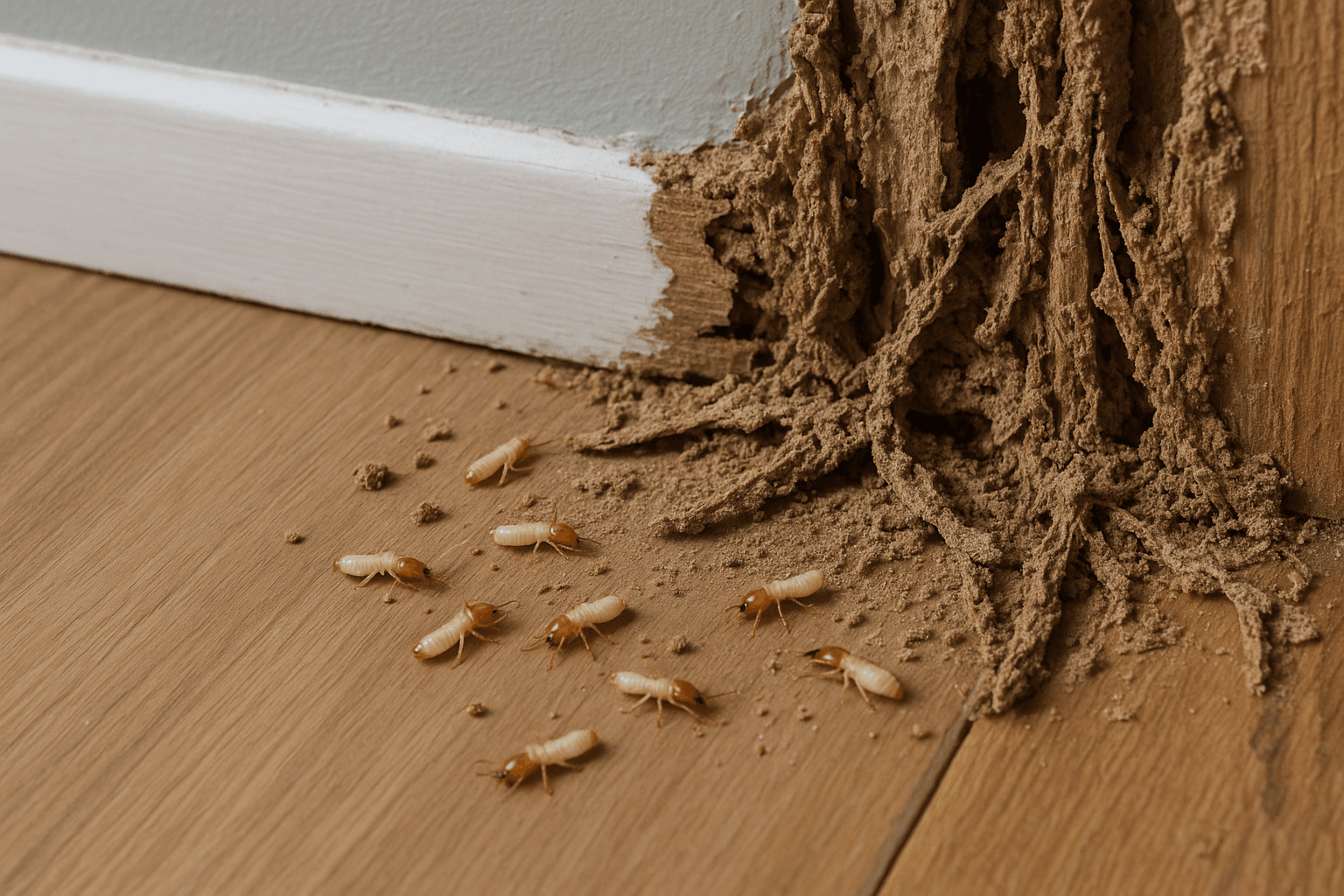
Living in Maricopa County basically implies that if you don’t have termites yet, you’re probably on the waiting list. It sounds harsh, but when you spot those distinct, muddy trails creeping up your foundation, the instinct to panic is pretty natural. You might be tempted to handle it yourself to save a buck, but when it comes to your biggest asset, cutting corners is a gamble that rarely pays off.
Contents
- 1 1. They Eat From the Inside Out (The Invisibility Factor)
- 2 2. Arizona Termites Are Built Different
- 3 3. Store-Bought Chemicals Are Repellents (And That’s Bad)
- 4 4. You Need Specialized Equipment to Reach Them
- 5 5. Identifying the Conducive Conditions
- 6 6. Real Estate and Resale Value
- 7 7. The Cost of Damage vs. The Cost of Prevention
- 8 8. Safety for Pets and Kids
- 9 9. We Know the Difference Between Flying Ants and Termites
- 10 10. The Warranty and Peace of Mind
1. They Eat From the Inside Out (The Invisibility Factor)
Here’s the thing about termites—they are masters of stealth. By the time you actually see a mud tube on your stem wall or notice a little pile of what looks like sawdust (it’s actually droppings, but we’ll get to that later), the colony has likely been feasting for months, maybe even years.
Subterranean termites, which are the main culprits here in Arizona, work silently behind your drywall. They consume the cellulose inside the wood, leaving the outer layer of paint or varnish perfectly intact. It’s deceptive. You walk past a wall every day thinking it’s solid, but behind the paint, it might look like a shredded honeycomb.
Professional termite inspectors know how to look for the signs that you can’t see. We listen for the hollow sound in the baseboards and check for moisture variations that signal activity. Relying on visual confirmation alone is a mistake because, honestly, by the time they show their faces, the damage is already done.
2. Arizona Termites Are Built Different
If you moved here from the Midwest or the East Coast, you might be used to termites that take their sweet time. The species we deal with in the Sonoran Desert, specifically the Heterotermes genus, are incredibly aggressive.
Our soil is dry, hard, and hot. To survive here, these termites have adapted to be relentless foragers. They will travel surprisingly long distances through the soil to find moisture and wood. A standard “bug spray” approach doesn’t work here because the pressure from the environment forces them to find a way into your home regardless of minor obstacles.
Arizona Termite Control requires specific knowledge of how these desert species behave during our intense summers and our monsoon seasons. A general pest control tip you read online might work in Ohio, but it won’t hold up against a hungry colony in Phoenix.
3. Store-Bought Chemicals Are Repellents (And That’s Bad)
This is the biggest misconception in the industry. You go to the hardware store, buy a bottle that says “Termite Killer,” and spray it where you saw the bugs. The termites disappear. Problem solved, right?
Wrong.
Most consumer-grade products are repellents. This means the termites sense the chemical, realize it’s dangerous, and simply turn around to find a different entry point into your home. You haven’t killed the colony; you’ve just rerouted traffic. You might have even trapped some inside your walls, forcing them to eat further up the framing to survive.
Professionals use non-repellent liquid termiticides (like Fipronil). Termites can’t smell, see, or taste these products. They walk right through the treated soil, get covered in the active ingredient, and unknowingly carry it back to the queen and the rest of the colony. It’s a “transfer effect” that wipes out the population at the source.
4. You Need Specialized Equipment to Reach Them
Let’s talk about your foundation. Most homes in Maricopa County are built on slab-on-grade foundations, often post-tension slabs. Termites live in the soil under that concrete.
Spraying the perimeter of your house is like putting a band-aid on a broken leg. To actually stop them, you need to create a barrier where the house meets the earth. This often involves:
- Trenching: Digging a moat around the foundation to saturate the soil.
- Rodding: Inserting a long metal tool into the earth to inject termiticide deep down.
- Drilling: Carefully drilling holes into the concrete (abutting slabs, patios, or garages) to inject protection underneath the slab.
Do you have a hammer drill and a pressure injection rig in your garage? Probably not. And even if you did, drilling into a post-tension slab without knowing where the tension cables are is incredibly dangerous. One wrong move and that cable can snap through the concrete like a whip. It’s better to let Arizona Termite Control handle the heavy machinery.
5. Identifying the Conducive Conditions
Killing the bugs is only half the battle. If you don’t fix the reason they showed up in the first place, they will just come back.
When we come out for an inspection, we aren’t just looking for bugs; we are looking for “conducive conditions.” This is industry jargon for “stuff that invites termites.” This could be:
- Wood-to-earth contact: A wooden fence post touching the house.
- Faulty grade: Soil piled up too high against the foundation, bypassing the stem wall.
- Moisture leaks: A dripping AC condensation line saturating the soil near the house.
A professional will point these out. We act as consultants to help you termite-proof your property. Sometimes, moving a woodpile or fixing a sprinkler head is just as important as the chemical Treatment.
6. Real Estate and Resale Value
Thinking about selling your home eventually? In Arizona, the Wood-Destroying Insect Inspection Report (WDIIR) is a standard part of almost every real estate transaction.
If a buyer’s inspector finds evidence of termites—even old damage—it can tank a sale or force you to lower your asking price significantly. However, if you have documentation showing professional treatment and a warranty, it turns a red flag into a green light. It shows you took care of the home.
Trying to explain to a buyer, “Oh, I sprayed some stuff I bought online last year,” isn’t going to fly. Lenders usually won’t approve a mortgage on a home with active infestation unless it’s been treated by a licensed company. Hiring a pro now protects your equity later.
7. The Cost of Damage vs. The Cost of Prevention
It’s easy to look at a quote for professional termite service and think, “I’d rather keep that money.” But you have to weigh that against the potential repair bills.
Termites cause billions of dollars in damage annually in the U.S., and homeowners insurance rarely covers it. Why? Because insurance companies view termites as a “preventable maintenance issue.”
Let’s break it down simply:
| Factor | DIY Approach | Professional Service |
|---|---|---|
| Initial Cost | \$50 – \$150 | Higher initial investment |
| Effectiveness | Low (Surface level) | High (Colony elimination) |
| Warranty | None | Usually 1-5 Years |
| Risk of Repair Bills | Very High | Very Low |
| Time Investment | Hours of labor | Zero (We do the work) |
Paying for professional treatment is essentially buying an insurance policy for your wood framing.
8. Safety for Pets and Kids
This might sound contradictory—hiring a professional to pump chemicals seems less safe than buying a can at the store, right? Actually, it’s the opposite.
When homeowners apply pesticides, they often over-apply or apply them in areas where runoff can occur. They might spray baseboards where a dog licks or a toddler crawls.
Licensed technicians are trained in target application. We place the termiticide into the soil, typically via a trench that is then covered back up, or injected directly into the concrete. This minimizes the risk of exposure to your family and pets. We know exactly how much to use to get the job done without creating an environmental hazard in your backyard.
9. We Know the Difference Between Flying Ants and Termites
Every monsoon season, we get calls from panicked homeowners seeing “flying termites” swarming their porch lights. Sometimes, they are right. Other times, they are flying ants.
To the untrained eye, they look almost identical. But the treatment for ants is totally different from the treatment for termites.
- Termites: Straight antennae, thick waist, equal-length wings.
- Ants: Elbowed antennae, pinched waist, unequal wings.
If you treat for ants when you have termites, the termites keep eating your house. If you treat for termites when you have ants, you wasted a lot of money. We provide accurate identification so you aren’t fighting a phantom enemy or ignoring a real one.
10. The Warranty and Peace of Mind
Honestly, this is the biggest reason. When you treat your own home, if the termites come back in six months, that’s on you. You have to buy more chemicals, do more digging, and stress out all over again.
When you hire Arizona Termite Control, you aren’t just paying for the liquid; you’re paying for the guarantee. If those little destroyers decide to return during your warranty period, so do we—for free.
There is a specific kind of relief in knowing that a certified, licensed expert has inspected the perimeter, treated the critical areas, and put their name on the line to say your home is protected. You can sleep soundly knowing your walls aren’t being eaten from the inside out.
Don’t Let Termites Devalue Your Home
Waiting “just a little longer” to see if the termites go away is a strategy that never works. In Maricopa County, termites are a question of when, not if. You need a team that understands the local species, the construction types, and the most effective methods for colony elimination.
Protect your investment. Let us handle the dirty work so you can get back to enjoying your home.
Ready to stop termites in their tracks?
→ Call us today: 480-660-3093
→ Or Click Here to Request a Free Inspection