
Living in Arizona means accepting two absolute truths: the summers are brutal, and the bugs are relentless. If you own a home here in Maricopa County, you probably already know that the question isn’t really if you’ll get termites, but rather when they’ll decide your wall studs look like a gourmet meal.
Contents
- 1 1. They Actually Kill the Colony (Not Just the Workers)
- 2 2. No Drilling Through Your Expensive Floors
- 3 3. A “Smart” Defense for Maricopa County Soil
- 4 4. Safety for Pets and Kids
- 5 5. 24/7 Monitoring Equals Peace of Mind
- 6 6. Comparison: Liquid vs. Bait
- 7 7. It Solves the “Hidden” Termite Problem
- 8 8. Environmental Responsibility
- 9 9. Dealing with Arizona’s Monsoon Season
- 10 10. Protection for Property Value
1. They Actually Kill the Colony (Not Just the Workers)
Here’s the thing about termites—killing the ones you see is satisfying, sure, but it’s kind of like putting a bucket under a leaky roof without fixing the hole. You aren’t solving the problem; you’re just managing the mess.
Old-school methods, like liquid barrier treatments, work by repelling termites or killing them on contact as they try to cross the treated zone. And that works, for a while. But termite bait stations operate on a completely different, much sneakier principle.
We use their own biology against them. Termites are social insects, which means they share food. When a worker termite finds the bait in one of our stations, they don’t just eat it and die right there. They carry it back to the colony. They share it with the soldiers, the larvae, and most importantly, the Queen.
Once the Queen dies, the colony collapses. It’s a total system shutdown. Liquid treatments can kill thousands of termites, but if the Queen is still pumping out eggs deep underground, you’re still in trouble. Bait stations aim for total elimination.
2. No Drilling Through Your Expensive Floors
Honestly, this is the biggest selling point for a lot of folks in Phoenix and Scottsdale. Think about your home’s construction. You might have beautiful travertine tile, custom pavers on the patio, or a stained concrete driveway.
To apply a liquid barrier correctly, technicians often have to drill holes every 12 inches through concrete slabs to pump the chemical into the soil below. It’s loud, it’s messy, and even if they patch it well, you know those holes are there.
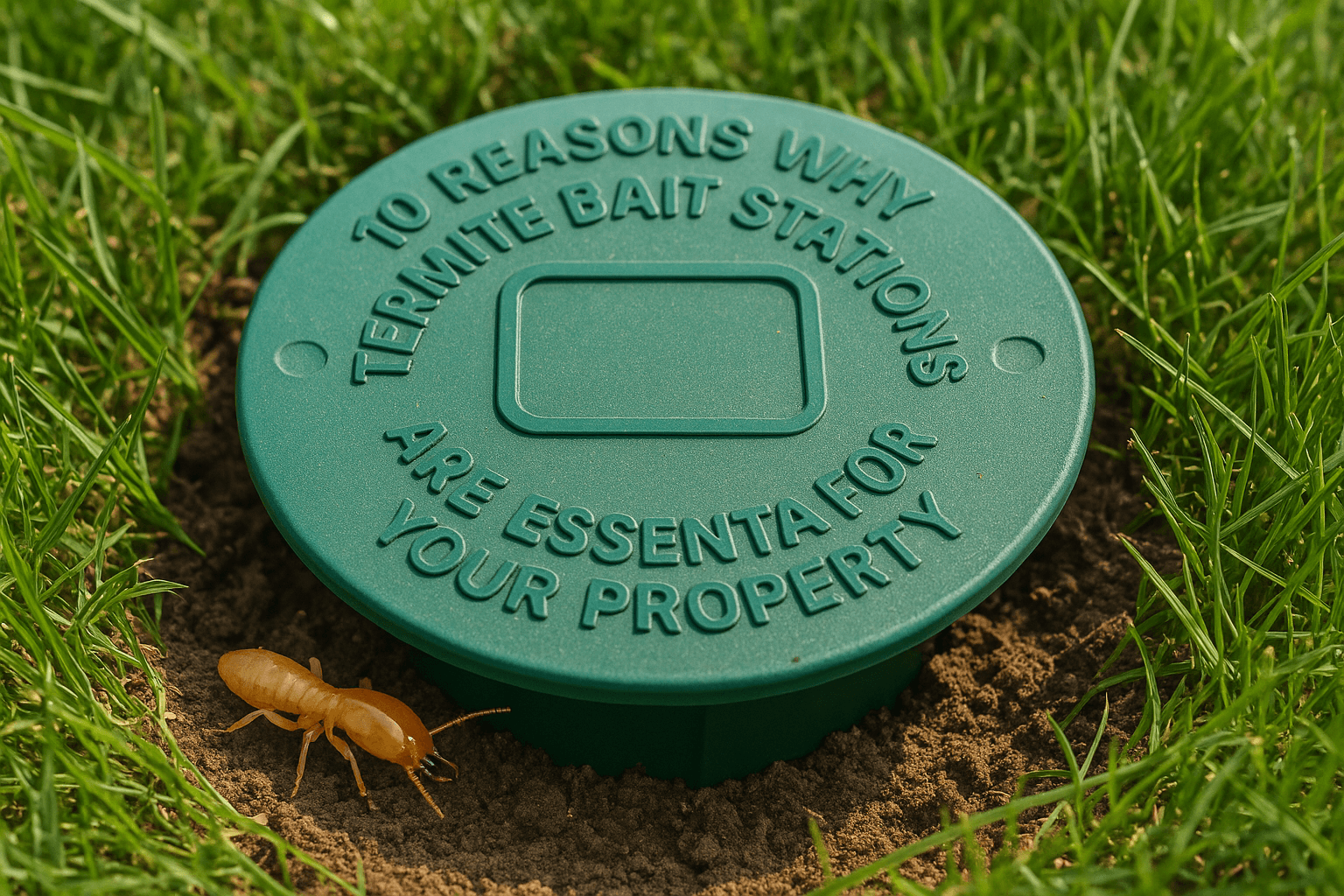
Termite bait stations are different. They are installed in the soil around the perimeter of your home. We dig a small hole in the dirt or landscaping rock, drop the station in so it sits flush with the ground, and that’s it.
There is zero need to take a heavy-duty masonry drill to your brand-new patio. If you have a post-tension slab foundation (which is super common in Arizona homes built after the 90s), drilling can actually be risky if you hit a tension cable. Bait stations side-step that risk entirely.
3. A “Smart” Defense for Maricopa County Soil
Let’s talk about the dirt for a second. If you’ve ever tried to dig a hole in your backyard in July, you know our soil is… challenging. We have a lot of caliche and hard-packed clay.
Liquid treatments rely on the chemical saturating the soil evenly to create a continuous curtain of protection. But in our hard Arizona soil, liquids can sometimes channel into cracks or fail to soak in deep enough, leaving “gaps” in the barrier that termites can slip through.
Subterranean termites are surprisingly good at finding those gaps. Bait stations don’t rely on soil saturation. They act as attractants. Termites are constantly foraging—looking for food 24/7. When they bump into a station, the bait inside is actually more palatable to them than wood. They prefer it. So instead of hoping the liquid soaked in perfectly everywhere, we are giving them something they want to eat that happens to be their undoing.
4. Safety for Pets and Kids
I get asked about this constantly, and rightfully so. If you have a dog that digs or kids who play in the yard, the idea of pumping gallons of chemicals into the ground might make you nervous.
While modern liquid termiticides are generally safe when dry, bait stations offer an extra layer of peace of mind. The active ingredient is locked inside a tamper-resistant station. It’s not sprayed over the mulch; it’s not puddling on the foundation.
Plus, the bait itself acts slowly on termites (stopping their molting process) but is incredibly specific to them. It targets a biology that mammals simply don’t have. So, even if Fido somehow managed to dig one up—which is hard to do—the risk is significantly lower than with broad-spectrum pest control sprays.
5. 24/7 Monitoring Equals Peace of Mind
You know how some people have security systems that alert the police the second a window breaks? Think of bait stations as that security system for your wood framing.
With a liquid Treatment, you spray it and hope it holds up for five years. But you don’t really know if it’s working until you see a mud tube crawling up your wall (which means they’re already back).
With a baiting system, Arizona Termite Control checks the stations regularly. We can actually see the activity. If we check a station and see termites have been feeding, we know the system is working, and we know the colony is being impacted. It changes termite control from a guessing game into a measurable science.
6. Comparison: Liquid vs. Bait
Sometimes it helps to see it laid out side-by-side. Here is a quick breakdown of how the two main methods stack up against each other.
| Feature | Liquid Barrier Treatment | Termite Bait Stations |
|---|---|---|
| Installation | Requires trenching and drilling concrete | Installed in soil; no drilling required |
| Colony Impact | Kills workers in the treated zone | Eliminates the entire colony (including Queen) |
| Visual Aesthetics | Drill marks may be visible on concrete | Flush with ground; virtually invisible |
| Environmental | High volume of chemical into soil | Minimal active ingredient; contained |
| Suitability | Good for immediate, localized control | Best for long-term Prevention and cure |
7. It Solves the “Hidden” Termite Problem
Termites in Arizona are sneaky. They don’t always come up the outside of the foundation where you can see their mud tubes. sometimes, they come up through “cold joints” in the concrete or around plumbing penetrations (like where your bathtub drain goes into the ground).
If termites enter from directly under the center of your house, a perimeter liquid treatment might not stop them. They bypass the barrier completely.
However, because termites forage radially (they wander around looking for food), they will eventually hit the bait stations around the perimeter of the home. By intercepting them outside and infecting the colony, we can stop them from coming up through those hidden interior cracks. It handles the threats you can’t see.
8. Environmental Responsibility
I’m not going to get all “save the planet” preachy on you, but it’s worth mentioning. A traditional liquid treatment for an average-sized home in Phoenix might use 100 to 200 gallons of diluted chemical solution. That is a lot of fluid going into the ground.
Bait stations use a few grams of active ingredient. That’s it.
If you are trying to reduce the chemical load around your property—maybe you have a vegetable garden nearby or you’re just conscious of groundwater—baiting is the clear winner. It’s surgical precision versus a shotgun blast.
9. Dealing with Arizona’s Monsoon Season
You know what happens in July and August. The sky opens up, and we get dumped on.
Heavy rains can sometimes shift soil or dilute older chemical barriers, especially if the drainage around your house isn’t perfect. While modern chemicals bind to the soil well, erosion is a real thing.
Termite bait stations are weather-resistant. They stay in the ground, doing their job regardless of whether it’s 115 degrees and dry or pouring rain. In fact, termites love moisture. When the ground gets wet during monsoon season, termite activity spikes. Having fresh bait in the ground right when they get active is the best timing you could ask for.
10. Protection for Property Value
Let’s be real for a second—your home is probably your biggest investment. In the current Maricopa County real estate market, a termite history can be a deal-killer or a major negotiation headache.
Having a baiting system installed is a proactive signal to potential buyers. It shows you haven’t just been ignoring maintenance; you’ve been actively protecting the asset. Plus, many baiting system warranties are transferable.
If you sell your house, telling the buyer, “It’s protected by Arizona Termite Control bait stations, and the warranty transfers to you,” is a massive value add. It removes the fear factor for them.
Why This Matters Now
Look, I’ve been in this industry long enough to see the damage these little guys can do. I’ve seen walls opened up where the studs looked like shredded wheat. It’s heartbreaking because standard homeowner’s insurance rarely covers termite damage. You are on the hook for the repairs.
It’s easy to put it off. You think, “I don’t see any bugs, I’m fine.” But subterranean termites are active 24/7, 365 days a year. They don’t sleep. While you’re watching TV, they’re eating. While you’re at work, they’re eating.
Using bait stations is about shifting from reactive (“Oh no, I have bugs!”) to proactive (“My home is a fortress”). It’s smarter, cleaner, and frankly, it just works better for the construction types we have here in the valley.
Let’s Secure Your Home
You don’t have to wait until you see a mud tube to take action. In fact, if you wait that long, damage has already been done. Let’s get a perimeter shield around your property and give those termites a final meal they won’t forget.
If you’re ready to protect your investment or just want a professional to take a look at your property, reach out to us. We know Arizona termites better than anyone.
Call Arizona Termite Control today at 480-660-3093
Or simply click here to [Request a Free Inspection] and we’ll come out to give you an honest assessment. Don’t let the bugs win.