
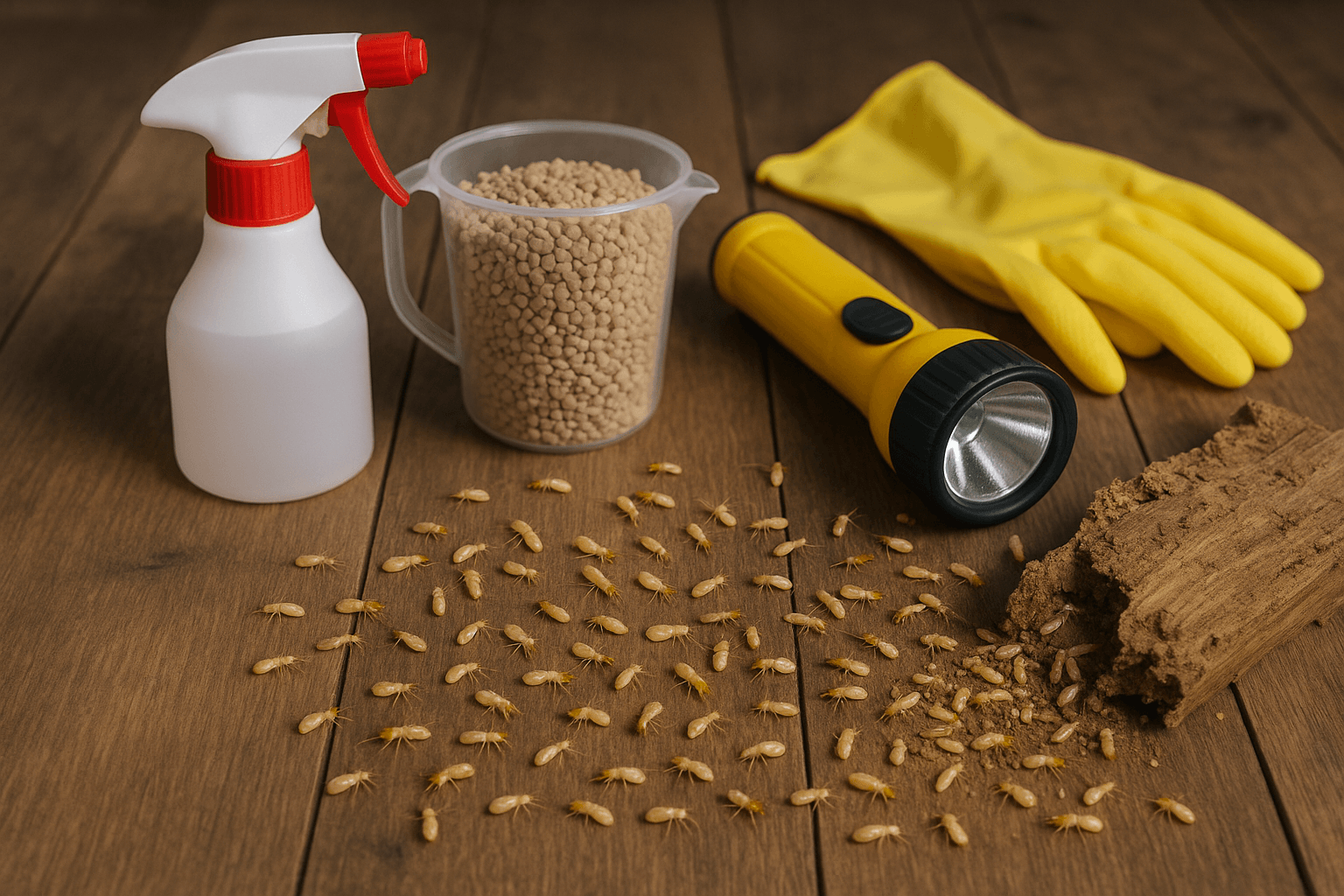
Finding a mud tube crawling up your foundation is enough to ruin anyone’s Saturday morning coffee, sending a cold shiver down your spine even in the middle of an Arizona summer. It starts with a faint scratching noise inside the wall or a weird pile of what looks like sawdust, and suddenly, you’re worrying about the structural integrity of your biggest investment. You want them gone, and honestly, you want them gone yesterday.
Contents
- 1 So, Can You Actually Handle This Yourself?
- 2 Know Your Enemy Before You Attack
- 3 The Wet Cardboard Trap: Low Tech, Low Risk
- 4 Beneficial Nematodes: Biological Warfare
- 5 Boric Acid: The Classic Powder
- 6 Diatomaceous Earth: The Physical Barrier
- 7 Orange Oil: The Smelly Solution
- 8 Prevention: The Best DIY Method
- 9 When “Safe and Simple” Isn’t Enough
- 10 Sometimes, You Need the Heavy Artillery
- 11 Let Us Handle the Dirty Work
So, Can You Actually Handle This Yourself?
Let’s be real for a second. We live in the age of YouTube tutorials and “life hacks.” You can learn how to bake sourdough, fix a leaky faucet, or change your own oil just by watching a five-minute video. So, it’s only natural to wonder if you can tackle a termite infestation on your own.
Living in Maricopa County, we deal with a specific kind of beast. The desert Subterranean termite is aggressive, hungry, and persistent. They aren’t just nuisance bugs; they are tiny demolition crews.
There are definitely methods out there—things you can buy at the big box hardware stores or mix up in your kitchen—that claim to wipe out termites. And some of them do work, to a degree. But here is the thing: dealing with termites isn’t like dealing with ants where you spray a line of poison and call it a day. It’s a battle of attrition.
If you are the type of person who loves a weekend project and doesn’t mind getting a little dirty (or sweaty, considering our heat), there are safe and simple ways to attempt eradication. Just keep in mind that “simple” doesn’t always mean “easy,” and it rarely means “permanent” without constant vigilance.
Know Your Enemy Before You Attack
You wouldn’t try to fix a plumbing leak with electrical tape, right? The same logic applies here. You need to know what you are looking at. In Arizona, we mostly see two types: Subterranean Termites and Drywood Termites.
Subterranean Termites live underground. They build those distinctive mud tubes up the side of your house to protect themselves from the sun and dry air while they travel to their food source (your wood framing). If you scrape a tube and see white, ant-like bugs, that’s them.
Drywood Termites, on the other hand, don’t need contact with the soil. They fly into vents or attics and start eating from the inside out. They leave behind droppings that look like coffee grounds or sand.
Why does this matter? Because a Treatment that kills one might not touch the other. Most DIY methods we are going to talk about are geared toward Subterranean termites because they are the most common headache for homeowners in the Valley.
The Wet Cardboard Trap: Low Tech, Low Risk
This is about as old-school as it gets. Termites eat cellulose (wood, paper, cardboard). They also love moisture. So, if you combine the two, you create an irresistible buffet.
How to do it:
- Get some corrugated cardboard boxes. The flat kind works best.
- Soak them in water until they are soggy but not falling apart.
- Stack them near where you suspect the termite activity is (like near that mud tube on the foundation).
- Wait.
It sounds too simple to work, but it does attract them. After a few days, check the cardboard. If you see termites feasting, take the cardboard away and burn it. Yes, literally burn it (safely, please).
The Catch: You are only killing the foraging workers. You aren’t killing the queen. It’s like swatting mosquitoes; satisfying, but it doesn’t stop the swarm. This is a population control method, not a total eradication strategy.
Beneficial Nematodes: Biological Warfare
Now we’re getting a little sci-fi. Nematodes are microscopic worms. You can’t see them with the naked eye, but to a termite, they are the stuff of nightmares. These little guys enter the termite’s body and release bacteria that kills the host within a couple of days.
You can buy these online or at some specialized garden centers.
The Process:
- Buy a package of beneficial nematodes.
- Mix them with water according to the instructions.
- Spray the mixture around the perimeter of your home or directly onto infected soil.
Because they are living organisms, they are safe for your kids, your dog, and your plants. They naturally hunt down Pests in the soil.
However…
Nematodes are fragile. They are sensitive to UV light and heat. In Maricopa County, where ground temperatures can fry an egg, keeping nematodes alive long enough to do their job can be tricky. You have to apply them at dawn or dusk and keep the soil moist. If the ground dries out, the nematodes die, and the termites win.
Boric Acid: The Classic Powder
Boric acid has been a staple in pest control for decades. It works by messing with the termite’s nervous system and dehydrating them. It’s relatively safe for humans (about as toxic as table salt), but you still don’t want to inhale it or let the cat eat it.
You can use it in a few ways:
- Powder form: Sprinkle it around the perimeter of your house or into cracks and crevices.
- Bait stations: Mix boric acid with sugar and water to create a paste, then leave it where termites can find it. They eat it, carry it back to the colony, and spread the poison.
Here is a quick breakdown of Boric Acid pros and cons:
| Pros | Cons |
|---|---|
| Inexpensive and easy to find | Lose effectiveness if it gets wet |
| relatively low toxicity to mammals | Slow-acting (takes weeks) |
| Can disrupt the digestive system of the colony | Hard to get deep into the soil |
The main issue with boric acid is application. Termites are smart. If they detect a threat, they might just seal off that tunnel and go around it. You have to be strategic.
Diatomaceous Earth: The Physical Barrier
You might have heard of Diatomaceous Earth (DE). It looks like white powder, but under a microscope, it looks like shards of glass. It’s made from fossilized aquatic remains. When a termite (or any exoskeleton bug) crawls over it, the powder cuts their outer shell, causing them to dry out and die.
How to use it:
Spread a thin layer of food-grade DE around the foundation of your home. You can also puff it into cracks in the wall.
It is totally non-toxic. You could eat it if you wanted to (though I wouldn’t recommend it; it’s gritty).
The Arizona Problem:
Like boric acid, DE only works when it’s dry. If your sprinklers hit it, or if we get one of those summer monsoons, it turns into a paste and becomes useless. Plus, subterranean termites tunnel under the dirt. Unless they surface right where you put the powder, they might never touch it.
Orange Oil: The Smelly Solution
This is more for Drywood termites, but it’s worth mentioning because people ask about it constantly. Orange oil contains d-limonene, which melts the exoskeleton of termites and destroys their eggs.
It smells great—like you just peeled a thousand oranges in your living room. You drill holes into the infested wood and inject the oil. It’s a contact killer.
Why it’s tricky:
It has zero residual effect. Once it dries, it’s done. If you miss a spot, the termites in that spot survive. It also doesn’t penetrate very deep into the wood. For a massive infestation in structural beams, orange oil is usually just a band-aid.
Prevention: The Best DIY Method
Honestly? The most effective thing you can do yourself isn’t killing the termites—it’s starving them. Termites need three things: food (wood), moisture, and shelter. If you cut off the moisture, you win half the battle.
Look around your house.
- Fix the AC drip line: Is it pooling water right next to your foundation? Extend that pipe away from the house.
- Check your sprinklers: Are they spraying your stucco? That keeps the wall soft and inviting.
- Wood-to-ground contact: Do you have a wood pile stacked against the back wall? Move it. Is your wooden fence touching the dirt? That is a termite superhighway.
In Arizona, water is life. If you have a leaky spigot creating a damp spot in the soil, you are practically putting up a neon “Open for Business” sign for the colony. Drying out the soil around your foundation is the single best “safe and simple” step you can take.
When “Safe and Simple” Isn’t Enough
Here is the hard truth about termite control. The methods we talked about above—traps, nematodes, surface powders—they mostly target the foragers. The workers.
But a termite colony is a complex organism. The queen is hidden deep underground, sometimes feet below the surface, pumping out thousands of eggs a day. You can kill ten thousand workers with boric acid, and the queen will replace them by next Tuesday.
Subterranean termites in Maricopa County are relentless. They can chew through drywall, flooring, and even soft metals to get to the wood. They build tubes over concrete. They find cracks as thin as a credit card.
Trying to eradicate a full-blown infestation with DIY methods often leads to a false sense of security. You stop seeing them for a few weeks, so you think you won. Meanwhile, deep inside the wall, they are still eating. By the time you see them again, the damage has doubled.
You know what? It’s frustrating. You try to do the right thing, save some cash, and handle business, but these pests are designed by nature to survive almost anything.
Sometimes, You Need the Heavy Artillery
There is a difference between repelling termites and eliminating them. Professional treatment usually involves trenching around the home and applying a liquid termiticide that binds to the soil, creating a continuous barrier. Or, it involves sophisticated baiting systems that trick the workers into carrying a slow-acting growth inhibitor back to the queen, collapsing the colony from the inside out.
These materials (like Termidor HE) are generally not available to the public because they require specific licensing to apply safely. And frankly, digging a trench around your entire house in 110-degree heat is nobody’s idea of a fun weekend.
If you have tried the cardboard traps, spread the Diatomaceous Earth, and fixed the leaks, but you are still seeing mud tubes or finding wings on your windowsill, it’s time to call in the cavalry.
Let Us Handle the Dirty Work
Look, we admire the DIY spirit. It’s part of what makes homeowners in Arizona so resilient. But your home is too valuable to gamble on nematodes and orange oil.
At Arizona Termite Control, we know exactly how these desert pests operate. We don’t just treat the bugs you see; we hunt down the colony you don’t see. We use industry-leading methods that are safe for your family and pets but absolutely devastating for termites.
Don’t let a small problem turn into a structural nightmare. Let us give you peace of mind (and save you from sweating it out in the yard).
Ready to protect your home?
Give us a call today at 480-660-3093.
Or, if you prefer, click here to Request a Free Inspection. We’ll come out, take a look, and give you an honest assessment—no pressure, just answers.