
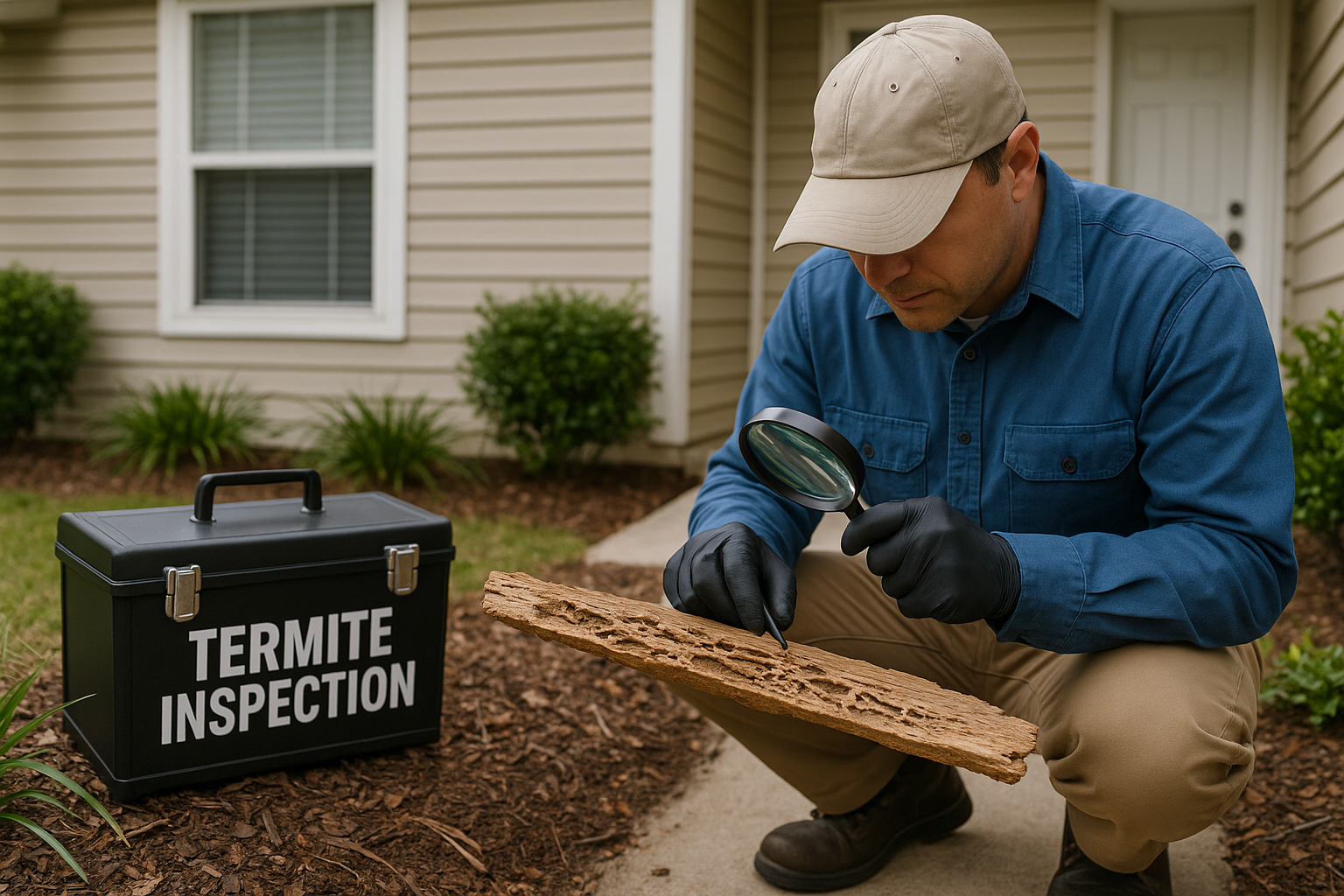
Living in the Valley of the Sun comes with a few unwritten rules: drink more water than you think you need, park in the shade whenever possible, and accept that termites are not a matter of “if,” but “when.” It’s a harsh reality for us in Maricopa County, but ignoring that tiny mud tube climbing up your foundation won’t make the problem disappear. In fact, that silence you hear in the walls? It might just be the sound of your home’s equity being slowly chewed away.
Contents
- 1 The “It’s Probably Nothing” Trap
- 2 Signs That Scream “Call a Pro”
- 3 What Actually Happens During an Inspection?
- 4 The Arizona Factor: Why Our Termites Are Different
- 5 Can’t I Just Handle This Myself?
- 6 The Cost of Waiting vs. The Value of Action
- 7 Why a “Free” Inspection Changes the Game
- 8 Don’t Let Termites Evict You
The “It’s Probably Nothing” Trap
You know what? We get it. Life is busy. Between work, getting the kids to school, and trying to keep the AC running during a Phoenix heatwave, the last thing you want to add to your to-do list is a pest inspection. It’s easy to look at a weird spot on the drywall or a little pile of what looks like sawdust and tell yourself, “I’ll deal with that next month.”
Here’s the thing, though. Termites don’t take breaks. They don’t take holidays, and they certainly don’t care that you’re busy. While you are waiting for a convenient time, Heterotermes aureus—our most common local Subterranean termite—is working a 24/7 shift eating the structural timber of your house.
There is a saying in our industry that ignorance is bliss until the ceiling starts to sag. By the time you notice visible damage, like buckling floors or hollow-sounding wood, the colony has likely been established for years. An immediate Termite Inspection isn’t just about finding bugs; it’s about stopping a financial hemorrhage before it becomes catastrophic. It is the gut-check your home needs.
Signs That Scream “Call a Pro”
Honestly, most homeowners in Arizona don’t know they have a problem until it’s staring them in the face. Termites are cryptic creatures. They hate the light and the open air, which makes sense given our desert climate. They stay hidden inside the wood or underground.
However, they do leave clues if you know where to look. We aren’t talking about giant neon signs, but rather subtle hints that the environment of your home has been compromised.
Here is a quick breakdown of what usually tips us off:
| Visual Clue | What It Usually Means | Where to Look |
|---|---|---|
| Mud Tubes | Subterranean termites are building tunnels to travel from the soil to your wood without drying out. | Foundation base, exterior stucco, or garage walls. |
| Discarded Wings | A “swarm” has occurred. Reproductive termites have left to start new colonies. This is a huge red flag. | Windowsills, near sliding glass doors, or spider webs in corners. |
| Frass (Droppings) | Drywood termites push their poop out of the tunnels. It looks like tiny piles of salt and pepper or sawdust. | underneath wooden furniture, baseboards, or attic eaves. |
| Blistered Paint | Termites have eaten the drywall paper or wood behind the paint, leaving only a thin layer of paint holding moisture. | Interior walls, often looking like minor water damage. |
If you spot any of these, panic isn’t the answer—action is.
What Actually Happens During an Inspection?
There is a misconception that a termite inspection involves a guy showing up with a flashlight, looking at the corners of the room for five minutes, and then handing you a bill. If that has been your experience, you didn’t get a real inspection.
A proper, professional evaluation is forensic. We are looking for evidence of wood-destroying organisms (WDO). It’s a mix of visual scanning and physical probing.
Let me explain how it typically goes down. We start with the exterior. We are checking the foundation line—where the house meets the earth. In Maricopa County, most homes are on concrete slabs. You might think, “Concrete blocks termites, right?” Wrong. Termites only need a crack the width of a Business card to squeeze through. They also travel up plumbing penetrations. We check the stem wall, the eaves, and the soil grading.
Then we move inside. We aren’t just looking at the walls; we are checking baseboards, door frames, and the inside of closets. We often use a tool to gently tap on the wood. Solid wood sounds a certain way; wood that has been eaten out from the inside sounds hollow, like paper.
It’s thorough, it’s invasive in the sense that we look everywhere, but it’s absolutely necessary. We are trying to construct a story of what is happening behind your walls.
The Arizona Factor: Why Our Termites Are Different
You might have friends back east who deal with termites, but the situation here is different. In the desert, moisture is scarce. This drives our subterranean termites to be incredibly aggressive in their search for resources. They live deep underground—sometimes up to 20 feet down—to escape the heat, coming up only to feed on the cellulose in your home.
Because our soil is so dry and hard (that lovely caliche clay we all struggle to garden in), termites use those mud tubes to bring moisture with them. They are essentially building their own humid highways up the side of your house.
Furthermore, we have “monsoon season.” When those humidity levels spike and the rains hit, it triggers swarming. If you have ever seen thousands of flying bugs suddenly appear around a streetlamp or your porch light in July or August, you’ve witnessed a swarm. That is the colony trying to expand. If that happens near your house, an immediate inspection is the only way to ensure they haven’t decided your attic is their new nesting ground.
Can’t I Just Handle This Myself?
This is a question we hear all the time. You walk into a big-box hardware store, see a bottle of “Termite Killer” on the shelf for twenty bucks, and think, Why pay a pro when I can just spray this?
It’s a fair question, but here is the brutal truth: DIY termite control is like putting a band-aid on a broken leg. It might make you feel like you’re doing something, but it doesn’t fix the underlying issue.
Store-bought sprays are typically repellents. They kill the termites they touch. Sounds good, right? Not really. When you spray a repellent, the termites just realize that specific spot is dangerous. They don’t die off; they just reroute. They will find another way into your home, often deeper and harder to detect.
Professional Treatment usually involves non-repellents. These are slow-acting agents that the termites don’t detect. They walk through it, carry it back to the colony, and spread it to the queen. It’s a biological time bomb for the termite population. You cannot buy that kind of technology off the shelf.
The Cost of Waiting vs. The Value of Action
Let’s talk money for a second. We know that homeowners are always juggling expenses. A new roof, a broken water heater, rising property taxes—it never ends. Adding a termite inspection fee or treatment cost can feel like a burden.
But you have to look at the alternative. The average cost to repair termite damage in a home can run into the thousands—sometimes tens of thousands—of dollars. And here is the kicker: most homeowners’ insurance policies do not cover termite damage. They consider it a preventable maintenance issue.
So, if a support beam in your attic is eaten through and causes a ceiling collapse, that comes out of your pocket. All of it.
Think of an inspection not as an expense, but as an insurance policy for your equity. You are protecting the asset that you work so hard to pay for every month. Plus, if you ever plan to sell your home in Phoenix, a clean termite report is almost always required during the closing process. Staying ahead of it puts you in the driver’s seat.
Why a “Free” Inspection Changes the Game
Some folks hesitate because they don’t want to pay just to be told their house is fine. It feels like throwing money away, right?
That is why the concept of a free inspection is so vital. It removes the barrier. It takes the risk off your shoulders. You get the peace of mind of knowing a certified professional has combed through your property, checked the danger zones, and evaluated the risk—all without opening your wallet.
If we find nothing? Great! You get to sleep soundly knowing your home is secure. If we find something? You caught it early. You stopped a small problem from becoming a structural nightmare.
There is really no downside to getting checked. The only downside is hoping for the best and finding out too late that the worst has happened.
Don’t Let Termites Evict You
Your home is your sanctuary. It’s where you relax after a long week, where you raise your family, and where you escape the Arizona sun. You shouldn’t have to share it with a million tiny intruders who view your framing as an all-you-can-eat buffet.
Termites are persistent, secretive, and destructive. But they are not unbeatable. With the right eyes on the problem and the right treatment plan, you can fortify your home against these desert destroyers. The most important step is the first one: simply looking.
Don’t wait until you see wings on the windowsill or mud on the stucco. Be proactive. Take control of your home’s health today.
Ready to protect your biggest investment?
We are standing by to help you clear your home of Pests and give you the peace of mind you deserve.
Give Arizona Termite Control a call right now at 480-660-3093.
Prefer to do things online? It only takes a second to Request a Free Inspection. Let’s kick those bugs out together.