
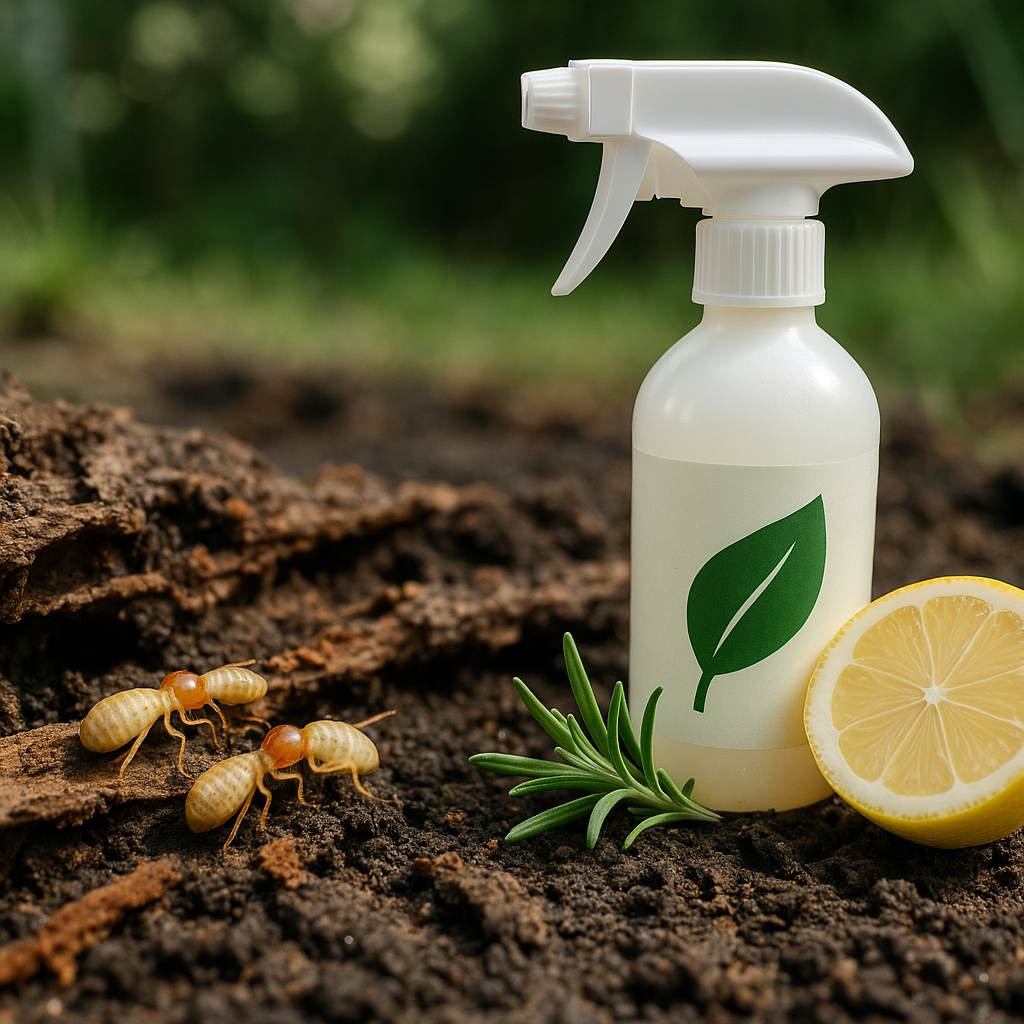
There is nothing quite like the sinking feeling of walking around the side of your house, maybe just to check the AC unit or water a cactus, and spotting a little mud tube crawling up the foundation. It’s a specific kind of dread that hits every Arizona homeowner eventually, usually followed by a frantic mental calculation of how much this is going to cost. But lately, the panic isn’t just about the damage to the wood; it’s about what needs to be sprayed to stop it.
Contents
- 1 The Shift Away from “Nuking” the House
- 2 Why Arizona Termites Are Different
- 3 Method 1: The “Trojan Horse” Bait Systems
- 4 Method 2: Beneficial Nematodes
- 5 Method 3: Borates (The Salt Solution)
- 6 Method 4: Physical Barriers
- 7 Method 5: Orange Oil (D-Limonene)
- 8 Comparing the Options
- 9 Prevention: The Ultimate Non-Toxic Strategy
- 10 Can “Green” Really Handle a Heavy Infestation?
- 11 A Note on “Natural” DIY Remedies
- 12 Let’s Protect Your Home, Naturally
The Shift Away from “Nuking” the House
You know what? For decades, the standard procedure for termite control was basically chemical warfare. The guy would show up in a suit that looked like he was handling plutonium, pump hundreds of gallons of something unpronounceable into the soil, and tell you to keep the dog away for a while. And sure, it killed the termites. It also made a lot of people uneasy.
We live in the desert. We understand that life here is resilient—scorpions, rattlesnakes, and yes, termites. But we also live in our homes with kids, golden retrievers, and maybe an organic vegetable garden in the back. The idea of saturating the ground with heavy toxins doesn’t sit right with everyone anymore.
Here’s the thing: You don’t have to choose between a structurally sound home and a non-toxic environment. Technology has caught up. There are methods now that are surgical rather than nuclear, targeting the pest without compromising the safety of your backyard ecosystem.
Why Arizona Termites Are Different
Before we get into the solutions, we have to look at the problem. If you’ve lived in Maricopa County for more than a summer, you know the heat is dry, but our soil—that hard-packed clay and caliche—holds moisture surprisingly well underneath concrete slabs.
The Heterotermes aureus, or the Desert Subterranean Termite, is our main enemy here. They are aggressive, they are hungry, and they don’t sleep.
Unlike their cousins in humid parts of the country, Arizona termites are masters of conserving moisture. They build those distinctive mud tubes to travel from the soil (their home) to the wood framing inside your walls (their buffet) without drying out.
Because they come from underground, simply spraying the surface of your wood often isn’t enough. You have to intercept them.
Method 1: The “Trojan Horse” Bait Systems
If you ask any expert in Integrated Pest Management (IPM), they’ll tell you that baiting is often smarter than barrier sprays. Think of it less like poisoning the ground and more like tricking the colony.
Systems like Sentricon operate on a fascinating biological principle. We install stations around the perimeter of your home. These stations contain a cellulose material (basically wood pulp) that termites actually prefer over the lumber in your walls.
Here’s the kicker: The bait contains a Chitin Synthesis Inhibitor.
That sounds technical, but it’s actually quite clean. Termites need to molt—shed their skin—to grow. This inhibitor stops them from being able to molt. When the worker termites find the bait, they don’t die immediately. They carry it back to the colony and share it with the queen and the soldiers.
It’s a slow-acting process, which is exactly what we want. If they died instantly, the other termites would learn to avoid the area. Instead, the colony collapses from the inside out. No gallons of liquid chemicals, no smell, and no risk to the groundwater.
Method 2: Beneficial Nematodes
This is where things get a little sci-fi, but in a natural way. Beneficial nematodes are microscopic, worm-like organisms that naturally live in the soil. To us, they are invisible and harmless. To a termite, they are a nightmare.
You can actually introduce these into the soil around your home. The nematodes hunt down termites (and other soil-dwelling Pests). When they find a host, they enter the termite’s body and release a symbiotic bacteria that kills the insect within roughly 48 hours.
Why use Nematodes?
- 100% Organic: It’s literally nature fighting nature.
- Pet Safe: Your dog could dig in the dirt five minutes later and be fine.
- Targeted: They don’t bother earthworms or plants.
However, in Arizona, we have to be careful with this one. Nematodes need a certain level of soil moisture to survive. If your yard is bone-dry rockscaping, this might be a challenge to maintain without regular irrigation.
Method 3: Borates (The Salt Solution)
You might have some Borax in your laundry room right now. Borates are mineral salts mined from the earth. They have been used for decades, but they are making a massive comeback in the green pest control movement.
The product usually comes as a liquid called Bora-Care. We apply it directly to the wood—studs in the wall, crawl spaces, or attic trusses.
The salt penetrates the wood fibers. When a termite tries to take a bite, the borate disrupts their digestive system. They starve. But because it’s a mineral salt, it doesn’t off-gas. It doesn’t degrade over time like synthetic pesticides. Once it’s in the wood, it stays there, keeping that wood inedible to termites, carpenter ants, and wood-boring beetles for years.
It’s exceptionally safe for mammals. Unless you plan on eating the 2x4s in your wall, you aren’t going to be affected by it.
Method 4: Physical Barriers
Sometimes the best offense is a good defense. This is more for new construction or major renovations, but it’s worth mentioning.
Stainless Steel Mesh: There is a product called Termimesh, which is exactly what it sounds like. It is a marine-grade stainless steel mesh with holes so tiny that termites cannot squeeze through them. It’s usually installed around pipe penetrations through the slab—those tricky spots where plumbing comes up through the concrete.
Sand Barriers: Believe it or not, sand can stop termites. But not just any sand. It has to be Basaltic Termite Barrier (BTB) particles. The particles are sized specifically so that they are too heavy for termites to move with their mandibles, but packed too tightly for the termites to crawl between. It’s low-tech, but it works.
Method 5: Orange Oil (D-Limonene)
You might hear a lot about Orange Oil. It smells like a cleaning product because it shares the same active ingredient: d-limonene, extracted from orange rinds.
How it works: It breaks down the exoskeleton of the termite, causing them to lose moisture and die.
The Reality Check: Honestly? Orange oil is fantastic for Drywood Termites—the kind that live inside a piece of furniture or attic beam. We can inject it right into the galleries, and it kills them on contact.
However, for our Arizona Subterranean Termites that live five feet underground? It’s less effective. It doesn’t have the residual power to wipe out a massive underground colony. We use it, but usually as a spot Treatment or in conjunction with other methods.
Comparing the Options
It can be overwhelming to weigh the pros and cons. Let’s break it down simply.
| Method | Best Used For | Safety Profile | Longevity |
|---|---|---|---|
| Bait Systems | Colony elimination (Subterranean) | Excellent (Contained) | Long-term (with maintenance) |
| Borates | Direct wood treatment | Excellent (Mineral based) | Permanent (if kept dry) |
| Nematodes | Soil treatment | Superior (Biological) | Varies (Needs moisture) |
| Orange Oil | Spot treatment (Drywoods) | Good (Strong odor) | Short-term contact kill |
Prevention: The Ultimate Non-Toxic Strategy
You want to know the absolute best non-toxic way to control termites? Don’t let them get comfortable in the first place. Arizona homes have specific vulnerabilities that we can fix without a single drop of pesticide.
1. Watch the Grade: The soil around your house should slope away from the foundation. If water pools against your stucco after a monsoon storm, you are practically ringing the dinner bell for subterranean termites.
2. The AC Drip Line: This is a classic Arizona problem. Your AC runs 10 months a year. That condensation line usually drips right next to the foundation. That constant wet spot in the dry desert is an oasis for termites. Extend that line away from the house.
3. Wood-to-Ground Contact: Do you have a wooden trellis touching the dirt? A firewood stack leaning against the garage? Remove them. You need a buffer zone.
4. Check the Stucco: Cracks in the stucco aren’t just cosmetic. They are highways. Seal them up.
Can “Green” Really Handle a Heavy Infestation?
This is the question we get asked most often. “I love the idea of eco-friendly, but I have thousands of bugs eating my bathroom wall. Does this stuff actually work?”
The answer is yes, but it requires precision.
Old-school chemical drenching was a “spray and pray” method. It relied on volume. Non-toxic and low-toxicity methods rely on biology and behavior. We have to understand exactly where the colony is and how they are moving.
It might take a few days longer to see full colony collapse with a bait system compared to a liquid poison, but the result is often more complete because you kill the queen, not just the foragers.
Plus, you sleep better at night. There’s a psychological comfort in knowing your home is protected by science rather than toxic sludge.
A Note on “Natural” DIY Remedies
A quick digression before we wrap up: You will see “hacks” online about using vinegar, cardboard traps, or even chili powder to stop termites.
While these might kill a few bugs on contact, please don’t rely on them to save your house. A mature termite colony in Maricopa County can contain hundreds of thousands of members. Killing twenty of them with vinegar is like trying to empty a swimming pool with a teaspoon. It feels like you’re doing something, but the water level isn’t changing.
Professional non-toxic methods are concentrated and scientifically formulated to transfer through the colony. DIY methods usually just annoy them enough to make them move to a different wall.
Let’s Protect Your Home, Naturally
At Arizona Termite Control, we live here too. We hike the same trails and deal with the same heat. We understand that you want your home to be a sanctuary, not a chemical storage facility.
We specialize in customized, environmentally responsible termite plans that actually withstand the Arizona pressure. Whether you have an active infestation that needs immediate (but safe) intervention, or you just want to make sure your biggest investment is secure, we can help.
Don’t let the fear of chemicals stop you from treating a termite problem. There is a better way.
Ready to get started?
Call us directly at 480-660-3093
Or click here to Request a Free Inspection
Let’s keep your home standing strong and your environment safe.