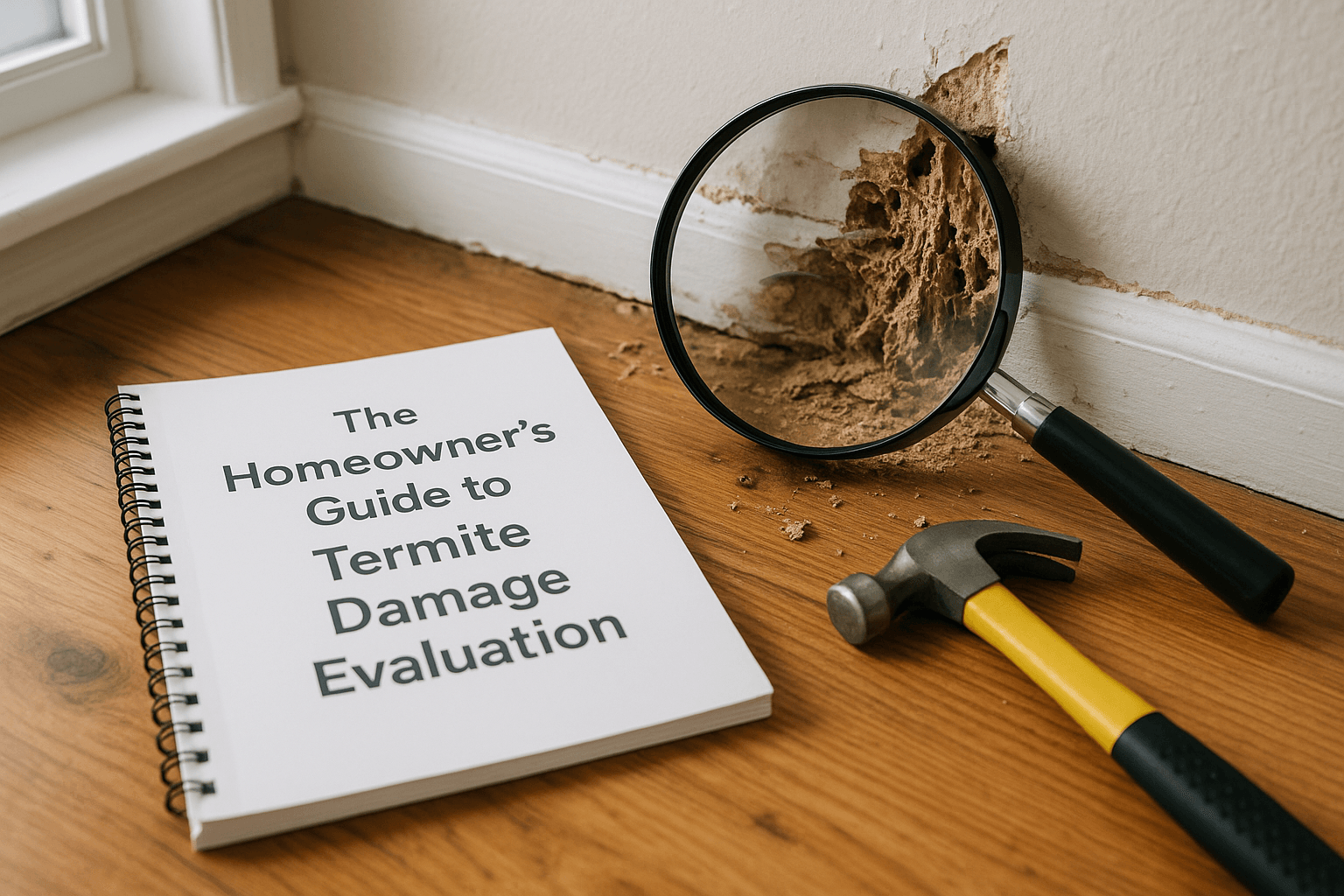
It starts with a subtle sinking feeling in your gut, usually while you’re doing something mundane like vacuuming the hallway or moving a bookshelf to find a lost outlet. You spot a weird, vein-like line of dried mud running up your foundation, or maybe the paint on the baseboard looks a little rippled, almost like water damage. You squint, lean in closer, and realize—with a heavy sigh—that you might be sharing your Maricopa County home with thousands of uninvited, wood-hungry guests.
Contents
- 1 The “It Won’t Happen to Me” Myth
- 2 Identifying the Signs: What Am I Looking At?
- 3 The “Poke Test” and Evaluating Wood Integrity
- 4 Cosmetic vs. Structural Damage
- 5 The “Old vs. Active” Dilemma
- 6 The Hidden Costs of Waiting
- 7 Navigating the Repair Process
- 8 Why The “Free Inspection” Matters
- 9 Let’s Protect Your Home Together
The “It Won’t Happen to Me” Myth
Here’s the thing about living in Arizona: we deal with scorpions, we handle the brutal summer heat, and we tolerate the dust storms. But termites? They feel like a violation. There’s a saying among industry folks here in the Valley that there are two types of homes: those that have termites and those that will get them. It sounds pessimistic, I know, but given our soil conditions, it’s just the reality of the desert.
Our local Subterranean termites—specifically the Heterotermes species—are incredibly resilient. They aren’t the big, scary bugs you see in movies; they are small, pale, and persistent. Because the Arizona sun is merciless, these termites build extensive tunnel systems underground to stay moist and cool. When they run out of food down there, they head up. Into your stem wall. Into your studs. Into your trusses.
You might think, “My house is block construction, I’m safe.” Honestly? That’s one of the biggest misconceptions out there. While the block won’t get eaten, everything attached to it is fair game. We’re talking furring strips, baseboards, door frames, and the entire roof structure. They will squeeze through a crack in a concrete slab thinner than a Business card just to get to the wood framing inside your walls.
Identifying the Signs: What Am I Looking At?
Before you can evaluate damage, you have to confirm you actually have a problem. You don’t need a degree in entomology to spot the basics, but you do need to know where to look.
The Mud Tube (Shelter Tube)
This is the smoking gun. Termites in Maricopa County are susceptible to desiccation—they dry out and die if exposed to our dry air. So, they build mud tubes to travel from the soil to the wood.
- What it looks like: A pencil-width tunnel made of soil and fecal matter (gross, I know).
- Where to find it: Check the exterior foundation of your home. Also, look in the garage on the stem wall, or inside closets where plumbing penetrates the slab.
Bubbling or Peeling Paint
Sometimes, it looks just like water damage. But if you haven’t had a leak and your wall looks like it has blisters, that could be termites tunneling right behind the paper of the drywall.
Frass (Termite Droppings)
This is actually more common with Drywood termites, which are less common here than Subterraneans but still pop up in older neighborhoods in Phoenix or Scottsdale. It looks like small piles of sawdust or coffee grounds.
The “Poke Test” and Evaluating Wood Integrity
Okay, let’s say you’ve found a spot that looks suspicious. How do you tell how bad the damage is? You’re going to need a screwdriver and a good flashlight. Maybe a deep breath, too.
In the industry, we call this “sounding” the wood. You want to tap on the wood frames or baseboards. Healthy wood sounds solid—a nice, dull thud. Termite-damaged wood sounds hollow, almost like you’re tapping on paper.
Here is a simple way to test suspicious wood:
- The Tap: Tap the handle of the screwdriver against the wood. Listen for that hollow echo.
- The Poke: If it sounds hollow, gently press the tip of the screwdriver against the wood.
- The Result: If the wood gives way easily or the screwdriver pushes right through into a honeycomb-like mess, you have structural compromise in that specific piece.
Subterranean termites generally eat the soft spring wood and leave the harder summer wood behind. This creates a distinct layering effect. If you peel back a piece of damaged wood and it looks like pages in a book or layers of cardboard, that is classic termite evidence.
Cosmetic vs. Structural Damage
This is the part that keeps homeowners up at night. Is the damage just ugly, or is my roof going to cave in?
Most of the time—and I mean most of the time—if you catch it relatively early, the damage is localized. However, because termites eat from the inside out, the outer surface of the wood can look pristine while the interior is shredded.
Here is a quick breakdown to help you categorize what you might be seeing:
| Feature | Cosmetic Damage | Structural Damage |
|---|---|---|
| Location | Baseboards, drywall paper, trim, door casings. | Load-bearing studs, rim joists, roof trusses, main support beams. |
| Visuals | Surface rippling, pinholes in drywall, mud spots. | Sagging floors, cracks above doors/windows, sticking doors. |
| Repair | Usually involves sanding, patching, or replacing trim. | Requires reinforcing (sistering) wood or total replacement. |
| Urgency | High (to stop infestation), but house is safe to live in. | Critical. requires immediate professional engineering assessment. |
The “Old vs. Active” Dilemma
If you bought a home in Maricopa County that was built before, say, 2010, there’s a decent chance it has had termites treated in the past. We see this all the time during Inspections. A homeowner finds a mud tube, panics, and calls us, only to find out the tube is ancient history.
How can you tell?
Active Infestation:
- The mud tube is moist or dark in color.
- If you break a small piece of the tube (about an inch), the termites will rebuild it within a few days.
- You might actually see cream-colored, ant-like workers spilling out if you break the tube.
Old (Inactive) Damage:
- The mud is dry, brittle, and crumbles into dust instantly.
- It is light in color, matching dry dirt.
- No movement inside, and the tube is not rebuilt after breaking.
However, and this is a big however—just because a tube is dry doesn’t mean they aren’t active five feet away. Termites are tricky. They abandon tubes all the time to start new paths. Assuming damage is old without a professional check is a risky gamble.
The Hidden Costs of Waiting
You know what? We humans are great at procrastination. We see a little spot on the wall and think, “I’ll deal with that next month.” But termites don’t take days off. They work 24/7.
In Arizona, a mature colony can eat about a foot of 2×4 wood in roughly six months. That doesn’t sound like much until you realize a single property can support multiple colonies, each containing up to a million termites.
The real trouble with damage evaluation isn’t usually the wood you can see; it’s the wood you can’t. Behind your shower, under your bathtub (trap doors under tubs are a termite superhighway), or deep in the attic insulation. By the time damage manifests on the painted surface of a wall, the framing behind it has likely been under attack for a while.
Let’s say the verdict is in, and you have damage. Now what?
First, do not repair the damage until the Treatment is done. I can’t stress this enough. If you replace a baseboard or patch drywall while the termites are still active, they will just eat the new material. It’s like putting a fresh steak in front of a hungry dog.
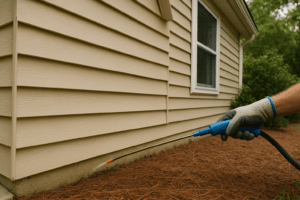
Once the colony is eliminated—usually through trenching and treating the soil around the foundation or drilling into the slab—then you can assess repairs.
For minor damage:
- Wood hardeners can sometimes be used on non-structural wood.
- Replacing baseboards is a simple Saturday afternoon project.
For major damage:
- “Sistering” is a common technique where a new, healthy piece of lumber is bolted to the damaged one to take over the structural load.
- In severe cases, you may need a licensed contractor to jack up sections of the house to replace plates or studs.
Why The “Free Inspection” Matters
There is a lot of jargon in our world—termiticides, linear footage, subterranean galleries—but it all boils down to protecting your investment. Your home is likely the most expensive thing you own.
While the “poke test” is a great first step for a homeowner, it lacks the depth of a professional inspection. We use moisture meters, specialized probing tools, and years of pattern recognition to find colonies that are trying their hardest to stay hidden. We know that if we see a tube here, they are likely heading there.
We also look for conditions that attract them, like faulty grading where water flows toward the house, or wood-to-earth contact (a big no-no). Identifying these “conducive conditions” allows you to prevent damage before it even starts.
Let’s Protect Your Home Together
Look, finding termite damage is stressful. It feels personal. But you don’t have to figure out the extent of the damage on your own. Whether you’re seeing active mud tubes, mysterious bubbling paint, or you just want the peace of mind that comes from knowing your home is solid, we are here to help.
Don’t let the silent destroyers eat away at your equity.
Get a professional set of eyes on the problem today.
Call Arizona Termite Control at 480-660-3093
Or click here to [Request a Free Inspection]
We’ll come out, take a look, and give you the honest truth about what’s happening in your walls. Let’s keep your home standing strong.