
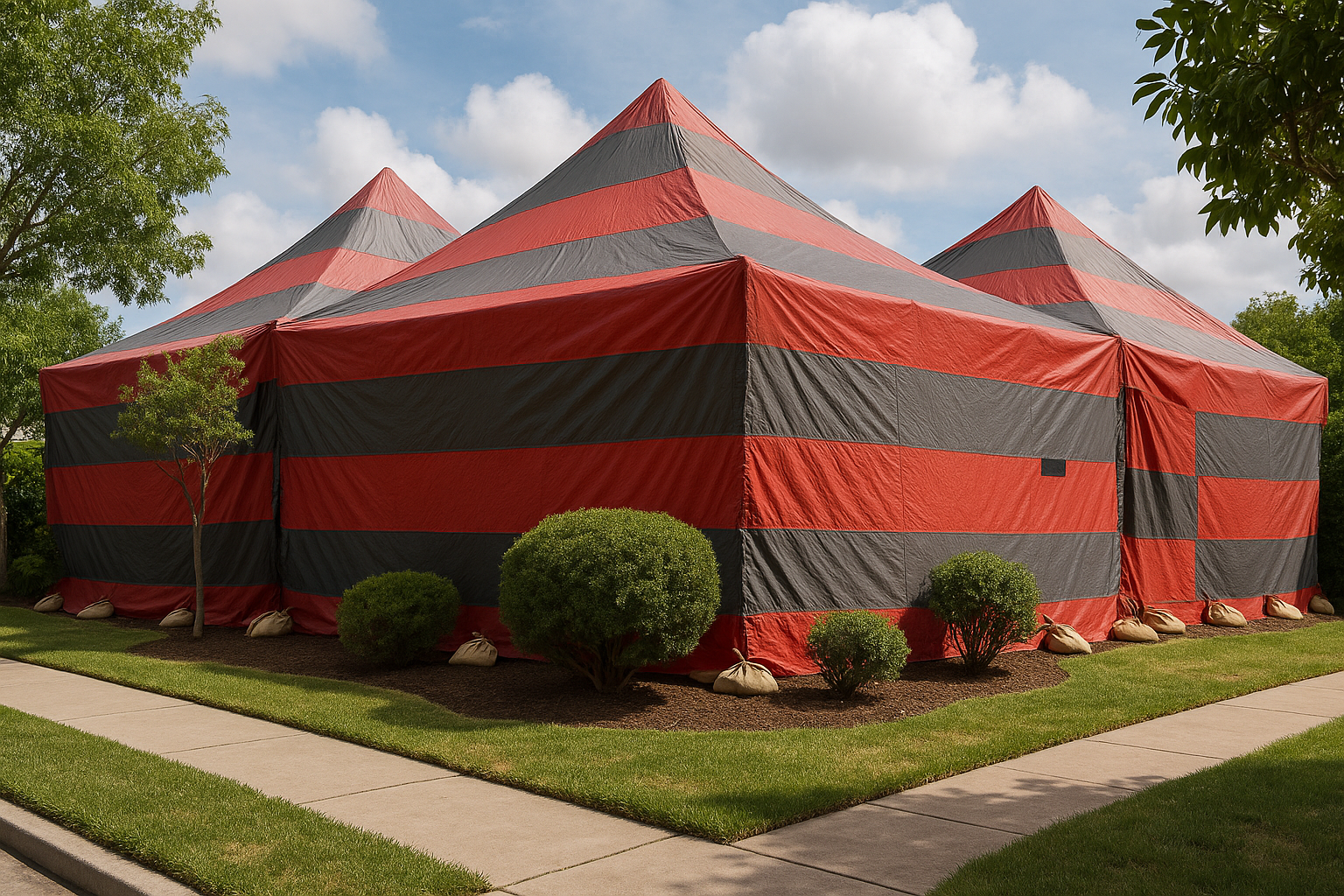
Hearing that your Maricopa County home needs termite fumigation is probably right up there with getting a root canal on your list of fun weekend activities. Honestly, just picturing that giant colorful tent draped over your roof is enough to make anyone’s blood pressure spike. But here’s the thing—understanding exactly what happens during the process makes the whole ordeal feel a lot less overwhelming.
So, Why the Big Tent Anyway?
You might be wondering why we cannot just spray some chemicals around the baseboards and call it a day. Let me explain. In Arizona, we generally deal with two main types of wood-destroying Pests: Subterranean termites and Drywood termites.
Subterranean termites live deep in the soil and build mud tubes to reach your house. Treating them usually involves trenching around your foundation and applying a liquid barrier. But drywood termites? They are a totally different breed.
These sneaky invaders do not need soil moisture to survive. They fly right into your attic, squeeze through tiny cracks in your eaves, and start eating your roof trusses from the inside out. Because they live deep inside the wood structure of your home, surface sprays simply will not reach them. The only guaranteed way to eliminate a severe drywood termite infestation is to use a gas that can penetrate every single piece of timber in the house.
That is exactly why termite fumigation in Maricopa County is so common. The tent traps the fumigant inside, forcing it into the microscopic pores of the wood where the colony is hiding.
Getting Ready: Your Pre-Fumigation Homework
I am not going to sugarcoat it; preparing for a fumigation takes some elbow grease on your part. Before our Arizona Termite Control team can even think about putting the tent up, your house needs to be totally prepped.
You know what? This is actually the part homeowners stress about the most, but if you take it step-by-step, it is very manageable. We will provide you with special, highly durable bags—usually called NyloFume bags—to protect your consumables.
Here is a quick breakdown of what you need to do:
- Bag or remove all unsealed food. Anything that is not in its original, factory-sealed glass or metal container needs to be double-bagged. This includes cereal, chips, baking supplies, and even that half-eaten bag of marshmallows in the back of the pantry.
- Clear out the fridge and freezer. Yes, even the cold food needs to be bagged or completely removed from the house. Many people just pack up coolers and take their food to a friend’s house.
- Do not forget the medicine and pet food. Any oral medications, vitamins, and dog or cat kibble must be bagged or taken with you.
- Prep your plants and pets. All living things must vacate the premises. Houseplants, fish tanks, cats, dogs, and hamsters all need a temporary vacation.
- Uncover the mattresses. If you have plastic covers on your mattresses or baby cribs, unzip them or take them off. The gas needs to flow freely through the fabrics.
It sounds like a lot of work, and admittedly, it is. But this prep work guarantees your family’s safety and ensures the Treatment is completely effective.
The Main Event: What Happens Under the Canvas?
Once you have packed your bags and handed over the keys, our crew takes over. Watching a professional team drape a massive, heavy-duty tarp over a house is actually pretty fascinating. We carefully roll the seams together and clamp them tight to create a perfectly sealed bubble around your home.
Inside that bubble, we release a specific fumigant gas—usually sulfuryl fluoride. It is an odorless, colorless gas that completely disrupts the termite’s nervous system. Because it is a gas, it expands to fill every single cubic inch of the space. It goes through drywall, behind cabinets, under the floorboards, and deep into the core of your wooden beams.
But wait, if the gas is odorless, how do we keep people from accidentally wandering in? Good question. We introduce a warning agent called chloropicrin before we pump in the main gas. Chloropicrin smells terrible and causes your eyes to water instantly—kind of like tear gas. It is a built-in safety alarm to ensure nobody (and no wandering wildlife) gets inside while the tent is active.
Here is a general timeline of how the days unfold:
| Fumigation Stage | What Our Team Does | How Long It Takes |
|---|---|---|
| Day 1: Sealing & Gassing | We tent the house, secure the perimeter, and introduce the fumigant. | 18 to 24 hours |
| Day 2: Aeration Process | We open specific vents in the tent and use massive fans to blow the gas out. | 12 to 24 hours |
| Day 3: Final Clearance | We test the air quality to ensure zero parts per million of gas remain. | 1 to 2 hours |
The Waiting Game (And Where You Should Go)
Since the process takes a few days, you will need a place to stay. Most homeowners treat this as an excuse for a mini-vacation. Maricopa County has plenty of amazing spots, so maybe book a couple of nights at a resort in Scottsdale or take a quick road trip up to Flagstaff to escape the heat.
If you are on a budget, crashing with family or friends is the usual route. Just remember to pack enough clothes, toiletries, and supplies for at least three full days. Sometimes, depending on the size of the house and the weather conditions—like those heavy summer monsoons—the aeration process might take a little longer. It is always smart to have a backup plan just in case you need an extra night away.
Why Bug Bombs Won’t Work (A Quick Detour)
Let us take a brief detour here because I hear this question all the time: “Can’t I just buy a dozen bug bombs from the hardware store and set them off in the attic?”
Honestly, please do not do this. Bug bombs—or foggers—only kill bugs that are out in the open. The aerosol mist they produce simply cannot penetrate solid wood. If you set off bug bombs, you might kill a few stray spiders, but the termites deep inside your rafters will just keep right on chewing. Even worse, the chemicals from foggers can leave a sticky, toxic residue all over your furniture and countertops.
Fumigation is a highly controlled, scientific process. DIY methods just delay the inevitable, allowing the termite damage in Arizona homes to get much worse—and much more expensive to repair.
Returning Home: Is It Really Safe?
This is the number one concern we hear from families: “Will my house be toxic when I move back in?”
The short answer is absolutely not.
One of the best things about sulfuryl fluoride is that it is a true gas. It does not settle on surfaces. It does not soak into your clothes. It leaves exactly zero residue behind.
Before we ever hand your keys back and take down the warning signs, our certified technicians walk through every room in your house with highly sensitive air-monitoring equipment. We check the ambient air, inside closets, and down in the lower levels. We measure the air quality down to a fraction of a part per million (ppm). We will not clear the house for re-entry until the air inside is just as fresh as the air outside.
When you walk back through your front door, you do not need to wash your dishes, scrub your countertops, or launder all your clothes. You can literally just unpack your groceries, let the dog off the leash, and go back to living your life. The only difference? Your home will be completely, 100% termite-free.
Let’s Protect Your Biggest Investment
Finding out you have an active infestation is stressful. Watching a colony slowly eat away at the equity of your home is a terrible feeling. But you do not have to figure this out alone. The team at Arizona Termite Control has guided thousands of Maricopa County residents through this exact process, and we know how to make it as smooth and painless as possible.
You deserve to sleep soundly at night without worrying about what is crawling inside your walls. If you suspect you have an issue, or if you just want peace of mind, reach out to us today.
Give us a call by phone # 480-660-3093 or Request a Free Inspection on our website. Let us get those pests out of your house for good.